
What Is Keyword Density?
Learn what keyword density is, how to calculate it, why it matters for SEO and how to optimize content naturally without keyword stuffing.

Quick summary
Keyword density is the percentage of times a keyword appears compared to the total number of words on a page. It can help you check whether a topic is mentioned clearly, but modern SEO depends more on search intent, content quality, readability, structure and helpfulness than on a fixed percentage.
Key takeaways
- Keyword density measures how often a keyword appears in your content.
- There is no perfect percentage that guarantees ranking.
- Natural writing, search intent and readability are more important than repetition.
- Use a Keyword Density Checker to review content before publishing.
What is keyword density?
Keyword density is a basic SEO metric that shows how frequently a specific keyword or phrase appears in a piece of content. It is usually expressed as a percentage of the total word count.
For example, if an article has 1,000 words and your main keyword appears 20 times, the keyword density is 2%. This can help you understand whether your keyword is present enough, too rare or repeated too aggressively.
Keyword density formula
The basic formula is:
Keyword density is useful as a quick content check, but it should not be treated as the main SEO goal. A page can have perfect density and still fail if it does not answer the searcher’s question.
How keyword density works
Keyword density works by comparing keyword mentions against total word count. A checker scans your text, counts repeated words or phrases and calculates the percentage of each term.
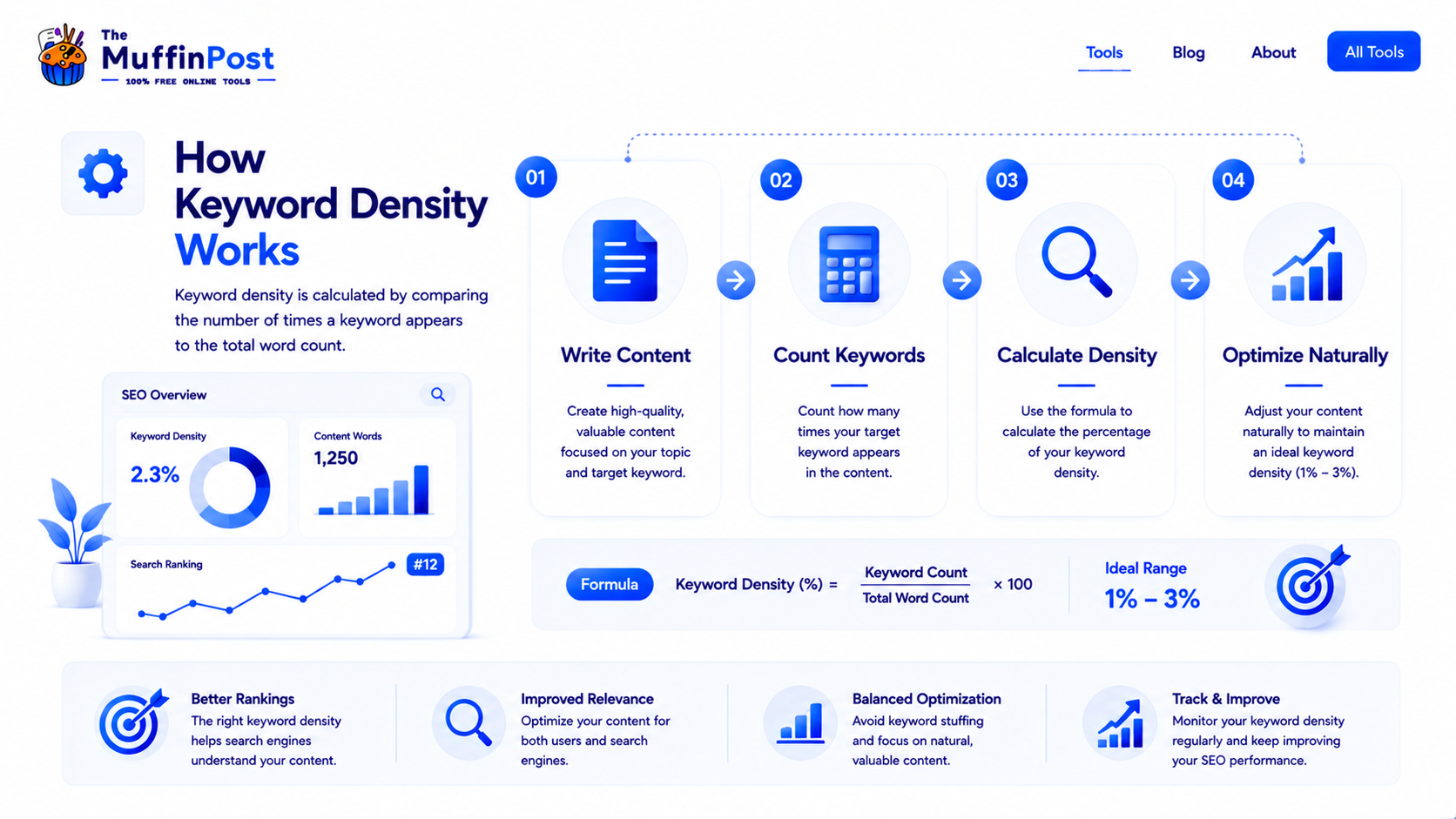
Count words
The total word count gives context to how often a keyword appears.
Count keywords
The tool checks how many times your target term appears in the text.
Review balance
The goal is to mention the keyword naturally without hurting readability.
Complete SEO content optimization workflow
Keyword density works best as one small checkpoint inside a broader SEO writing process.
Draft the Content
- Define search intent
- Create an outline
- Write naturally
- Check word count
Analyze Keyword Use
- Paste the draft
- Review frequency
- Check percentages
- Spot repetition
Improve Relevance
- Add useful variations
- Strengthen headings
- Cover related questions
- Improve clarity
Protect Readability
- Remove stuffing
- Shorten awkward phrases
- Read aloud
- Publish naturally
What is the ideal keyword density?
There is no official ideal keyword density that guarantees SEO rankings. Many writers aim for a natural range around 1% to 3%, but this is only a guideline. The best density is the one that helps the topic feel clear without making the text repetitive.

| Keyword density | Meaning | Recommendation |
|---|---|---|
| Under 1% | May be too low for topic clarity | Add natural mentions where useful. |
| 1–2% | Usually natural | Good range for many articles. |
| 2–3% | Still acceptable if readable | Review for repetition. |
| Over 5% | May feel over-optimized | Reduce exact-match repetition. |
Does keyword density still matter for SEO?
Keyword density can still be useful as a content quality check, but it is not the main ranking factor. Search engines evaluate whether the content satisfies search intent, covers the topic well and provides a helpful user experience.

Search intent
The page should answer what the user actually wants to know.
Content quality
Helpful, clear and complete content usually performs better than repeated keywords.
Internal links
Relevant links help users and search engines understand topic relationships.
Common keyword density mistakes
The most common mistake is trying to repeat the exact same keyword too many times. This can make the content sound unnatural and reduce readability.
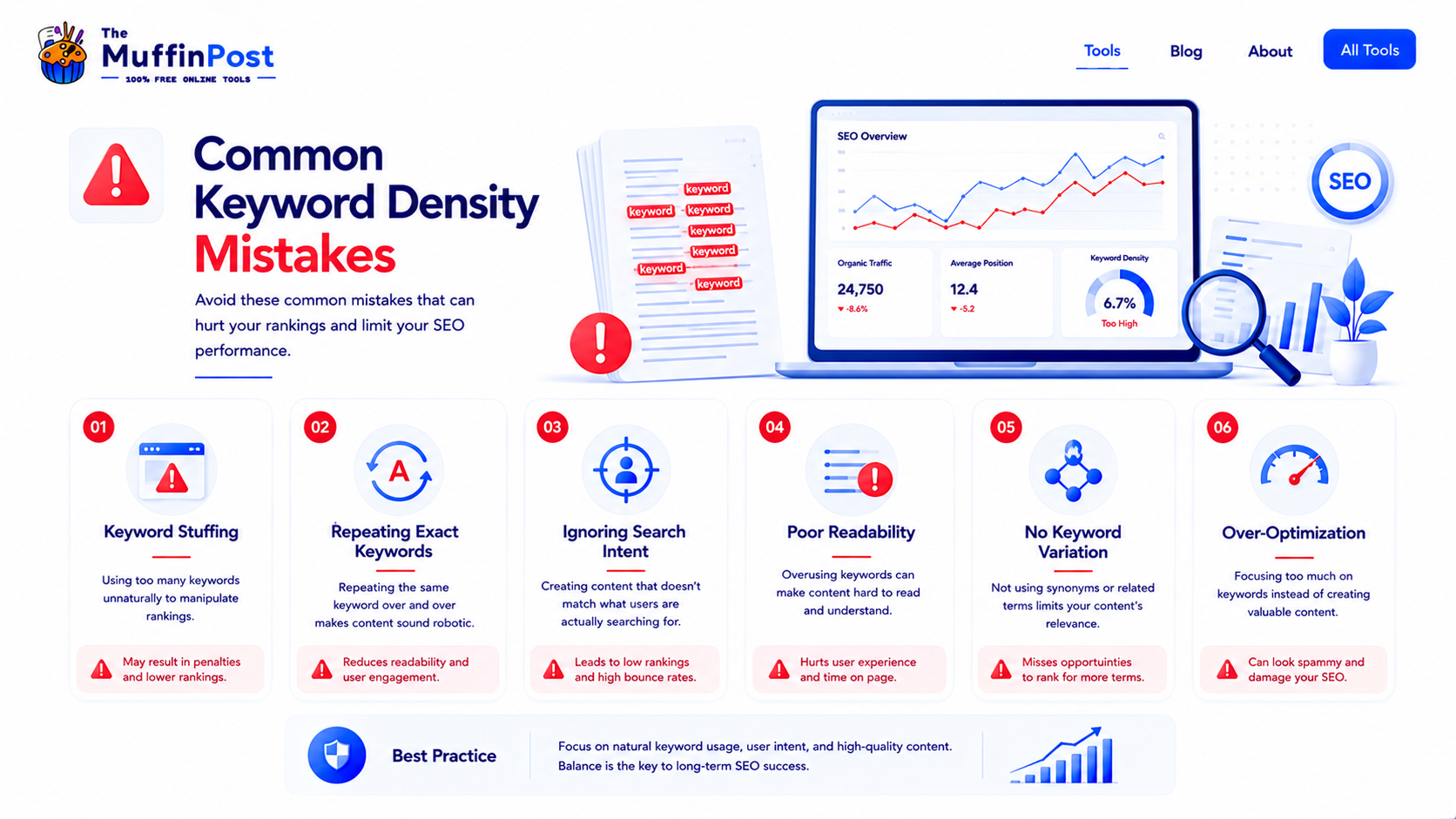
Repeating the same keyword unnaturally can hurt readability and make the page look low quality.
A page can mention the keyword often and still fail if it does not answer the question well.
Using related terms, synonyms and natural phrases often improves topic coverage.
Keyword density best practices
The best approach is to write naturally, place keywords where they help the reader and use variations to cover the topic completely.

Use the keyword early
Include the main keyword in the title, introduction and at least one heading when natural.
Add variations
Use related phrases such as keyword frequency, SEO writing and content optimization.
Check before publishing
Run your draft through a density checker to catch repetition or missing terms.
Start here: analyze keyword usage
Review keyword frequency, density and word count before publishing your SEO content.
Open Keyword Density CheckerOpen Word CounterSEO and Content Learning Center
Continue with practical guides for content optimization, readability and text workflows.
Frequently asked questions
What is keyword density?
Keyword density is the percentage of times a keyword appears compared to the total number of words on a page.
How do you calculate keyword density?
Divide the number of keyword mentions by the total word count, then multiply by 100.
What is a good keyword density for SEO?
There is no perfect number, but many writers use 1% to 3% as a natural guideline while focusing on readability.
Is keyword density still important?
It can be useful as a content check, but search intent, quality, structure and helpfulness matter more.
What is keyword stuffing?
Keyword stuffing means repeating keywords unnaturally in an attempt to manipulate rankings.
Can high keyword density hurt SEO?
Yes. If repetition makes the content unnatural or hard to read, it can hurt user experience and content quality.
Should I use keyword variations?
Yes. Keyword variations, synonyms and related terms help make the content more natural and complete.
Which tool can I use to check keyword density?
You can use a Keyword Density Checker to analyze keyword frequency and percentage instantly.

About the author
The MuffinPost Editorial Team creates practical guides for online tools, productivity, file conversion, calculators, marketing workflows and developer utilities.
Optimize keywords without hurting readability
Check frequency, remove repetition and publish content that feels natural to readers.
Check Keyword DensityBrowse Text Tools